Lesson 14 of 15 · ~22 min
Authentication and Authorization
Identity vs permission.
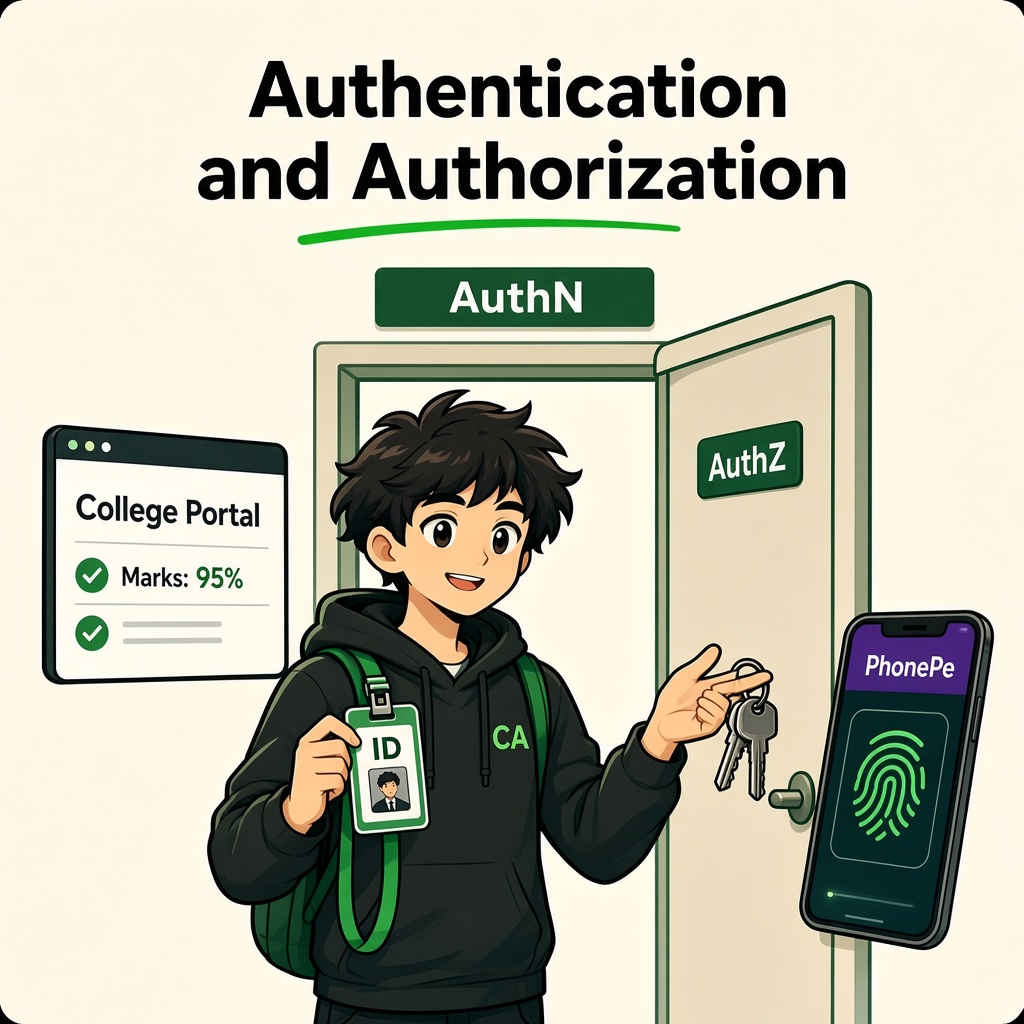
Authentication and Authorization
Course: Cybersecurity Fundamentals
Level: Beginner
Topic: Identity vs Permission, RBAC, Sessions, and Common Failures
1. Learning Objectives
By the end of this lesson, you will be able to:
- Define authentication (AuthN) and authorization (AuthZ) and never conflate them.
- Explain identity, credentials, and factors in practical terms.
- Describe sessions, cookies, and tokens at a high level.
- Apply RBAC (Role-Based Access Control) to organize permissions.
- Recognize IDOR and missing function-level checks as authorization bugs.
- Map AuthN/AuthZ failures to real breach themes (API leaks, token theft).
- Design mental checklists for “who are you?” vs “what may you do?”
2. The Two Questions Every System Must Answer
Every secure application answers two distinct questions:
| Question | Security term | Example |
|---|---|---|
| Who are you? | Authentication | Password, passkey, smart card |
| What are you allowed to do? | Authorization | Read own invoice vs admin delete user |
Authentication without authorization is incomplete: logging in does not mean you may access every record.
Authorization without authentication is dangerous: anonymous APIs that guess IDs can leak data.
Memory trick
AuthN = badge at the door.
AuthZ = which rooms your badge opens.


Fingerprint unlock on a payment app → AuthN.
Paying only from your linked bank account → AuthZ.
3. Identity, Credentials, and Subjects
| Term | Meaning |
|---|---|
| Identity | Stable label (username, email, subject ID in OIDC) |
| Credential | Proof (password, OTP, private key, ticket) |
| Subject | The authenticated party (user, service account, device) |
| Principal | Active security identity during a session |
Service accounts and API keys are identities too — not just humans.
4. Authentication Factors
| Factor | Something you… | Examples |
|---|---|---|
| Knowledge | know | Password, PIN |
| Possession | have | Phone, hardware key, smart card |
| Inherence | are | Fingerprint, face (with liveness concerns) |
Multi-factor authentication (MFA) uses two or more different factor types. Password + security question (both knowledge) is weak MFA. Password + TOTP app is stronger.
5. Authentication Mechanisms (Survey)
| Mechanism | Notes |
|---|---|
| Password | Still ubiquitous; must be unique + MFA for high value |
| Passkeys / WebAuthn | Phishing-resistant; covered in next lesson |
| OAuth 2.0 / OpenID Connect | “Login with Google” — delegates AuthN to identity provider |
| SAML | Common in enterprise SSO |
| Certificates (mTLS) | Machine-to-machine, high assurance |
| Kerberos | Windows domain tickets |
OAuth is often confused with AuthN — it can delegate identity, but your app must still enforce AuthZ on every API call.
6. Sessions and Tokens
After successful AuthN, systems track state:
| Approach | How it works | Risks |
|---|---|---|
| Server-side session | Session ID in cookie; state on server | Session fixation, theft if cookie not HttpOnly/Secure |
| JWT (JSON Web Token) | Signed (sometimes encrypted) claims in client | If stolen, bearer access until expiry; avoid long-lived JWTs in localStorage for XSS reasons |
| Opaque token | Random ID; validated server-side | Better revocation if store supports it |
6.1 Cookie attributes (web)
| Flag | Purpose |
|---|---|
| Secure | Send only over HTTPS |
| HttpOnly | JavaScript cannot read — mitigates some XSS theft |
| SameSite | Reduces cross-site cookie sending (CSRF help) |
6.2 Session lifecycle
- Login → issue session/token with expiry.
- Each request → validate session + re-check authorization for the action.
- Logout → invalidate server-side session or revoke refresh token.
- Idle timeout + absolute timeout limit exposure.
Never authorize based only on “they have a valid session” without checking resource ownership.
7. Authorization Models
7.1 Discretionary ACLs (ACL)
Owner of a file sets who may read/write — classic Linux/Windows file ACLs.
7.2 RBAC — Role-Based Access Control
Users receive roles; roles bundle permissions.
| Role | Permissions (example) |
|---|---|
student | View own grades |
instructor | View/edit grades for assigned courses |
registrar | Enroll students, full grade export |
admin | Manage users and roles |
Benefits: Easier audits (“who has admin?”), consistent onboarding/offboarding.
Pitfalls: Role explosion, static roles without attribute checks (department, clearance).
7.3 ABAC — Attribute-Based Access Control
Decisions use attributes: user department, resource classification, time of day, device compliance. Common in Zero Trust policies.
7.4 ReBAC — Relationship-Based
Access derived from graph relationships (Google Zanzibar model) — “edit if owner or editor.”
For fundamentals, RBAC + resource ownership checks covers most app bugs.
8. Authorization in Applications
Every sensitive operation needs:
- Authentication — valid session/token.
- Authorization — subject may perform this action on this object.
Check at:
- API layer (mandatory)
- Business logic layer (defense in depth)
- Database (row-level security where available)
8.1 IDOR — Insecure Direct Object Reference
Classic bug: user changes ?invoiceId=1001 to 1002 and views another customer’s invoice.
AuthN succeeded; AuthZ failed.
Fix: server loads invoice only if invoice.ownerId == session.userId (or role permits).
8.2 Horizontal vs vertical privilege escalation
| Type | Meaning |
|---|---|
| Horizontal | Access peer users’ data at same privilege level |
| Vertical | Gain admin capabilities without assignment |
Both are authorization failures.
8.3 Function-level vs object-level
| Missing check | Example |
|---|---|
| Function-level | Any logged-in user hits /admin/deleteUser |
| Object-level | User A edits User B’s profile |
Test both in authorized labs only.
9. Federation and SSO (Awareness)
Single Sign-On lets one identity provider (IdP) authenticate users for many apps (service providers).
Flow (simplified OIDC):
- App redirects to IdP login.
- User authenticates (with MFA at IdP).
- IdP returns ID token / code to app.
- App establishes local session.
AuthZ remains local: SSO does not mean every app user is admin.
10. Common Anti-Patterns
| Anti-pattern | Why it fails |
|---|---|
| Hidden admin URLs | Attackers discover paths |
| Client-side only checks | Bypass via direct API calls |
| Role in JWT never revalidated | Stale roles after demotion |
| “Admin” boolean in cookie | Forged client state |
| Global API keys in mobile apps | Extractable from APK/IPA |
11. Logging and Monitoring
Log authorization denials (without leaking secrets):
- Subject ID
- Action attempted
- Resource ID (hashed if sensitive)
- Outcome
Spikes in 403 responses or unusual admin actions may indicate probing.
12. Case Study Themes: Large Platforms and APIs
Public reporting on major platforms repeatedly highlights:
- Broken access control in APIs (OWASP #1 category in many years).
- Scraping enabled when pagination tokens do not enforce ownership.
- Over-broad tokens (GitHub, cloud provider keys) causing deep impact when leaked.
Lesson: AuthN establishes identity; every read/write must enforce AuthZ against that identity.
13. Case Study: Stolen Credentials and Broad Tokens
Historical incidents involved stolen OAuth tokens, PATs, or session cookies with wide scope.
Lesson: Short lifetimes, refresh rotation, step-up MFA for sensitive actions, least-privilege scopes.
14. Practical Lab: AuthN vs AuthZ on Your Own Apps or OWASP Juice Shop (Local)
Objective: Separate the two concepts hands-on — only authorized targets.
Option A — Thought exercise (no hacking)
- Pick Gmail: list three AuthN steps and three AuthZ rules (e.g., cannot read others’ mail).
- Draw a table: Action | AuthN required? | AuthZ rule?
Option B — Local OWASP Juice Shop (if you run it locally)
- Register two users Alice and Bob.
- Log in as Alice; note an API call that returns only Alice’s data.
- Attempt to access Bob’s cart or profile by changing an ID — observe 403/401 when fixed vs leak when vulnerable (document for class discussion).
Option C — Your web project
- Add middleware:
requireAuthvsrequireRole('admin')— explain difference in comments.
Never test IDOR on production sites you do not own.
15. Knowledge Check
Q1. Entering a password at login is primarily which process?
A. Authorization
B. Authentication
C. Accounting
D. Auditing only
Q2. Changing a URL parameter to view another user’s order without permission is a failure of:
A. Authorization
B. DNS
C. Authentication only if password weak
D. Compression
Q3. RBAC assigns permissions based on:
A. Random IP addresses
B. Roles mapped to permissions
C. MAC addresses only
D. Browser language
Q4. An HttpOnly session cookie primarily mitigates:
A. Some XSS-based cookie theft
B. All phishing
C. DDoS attacks
D. Hard drive failure
Q5. OAuth “Login with Google” primarily helps with:
A. Delegated authentication
B. Automatic admin rights in your app
C. Removing need for HTTPS
D. Database indexing
Q6. A valid JWT in Authorization header proves identity, but your API must still:
A. Skip authorization for speed
B. Enforce authorization for each action and resource
C. Trust any claim forever
D. Disable logging
Q7. Vertical privilege escalation means:
A. Gaining higher privileges (e.g., admin) than assigned
B. Reading only your own files
C. Changing DNS records
D. Using two monitors
Q8. Which is the best description of AuthZ?
A. Proving who you are
B. Deciding what an authenticated subject may do
C. Hashing passwords
D. Assigning IP addresses
Q9. MFA with password + authenticator app uses factors:
A. Knowledge + possession
B. Knowledge + knowledge
C. Possession + possession
D. None
Q10. Server-side session invalidation on logout helps because:
A. Stolen session IDs may stop working when revoked
B. It increases password length
C. It disables TLS
D. It removes need for RBAC
Answer Key
- B
- A
- B
- A
- A
- B
- A
- B
- A
- A
16. Lesson Summary
Authentication verifies identity; authorization enforces what that identity may access. Sessions and tokens carry proof of AuthN but must not replace per-request AuthZ checks. RBAC scales permission management, yet object-level checks stop IDOR. Real breaches often combine stolen credentials with missing or coarse authorization.
Remember: Logged in ≠ allowed. Test access control on authorized lab systems only.
17. Coming Next: Password Security and MFA
The next lesson covers password hygiene, phishing-resistant MFA, passkeys, and FIDO2 — turning authentication from a single weak factor into layered defense.
CYNARKS Academy – Learn to Understand. Practice to Defend.
Practice only on systems and networks you own or have explicit authorization to test.
End of lesson
Quiz · Tasks · Labs
Pass the quiz (≥70%), check off tasks, then mark the lesson complete to earn Foundations badges.
Scenario check
Real situations — apply the lesson logic; avoid pure memorization.
Answer all, then submit1. Entering a password at login is primarily which process?
2. Changing a URL parameter to view another user’s order without permission is a failure of:
3. RBAC assigns permissions based on:
4. An HttpOnly session cookie primarily mitigates:
5. OAuth “Login with Google” primarily helps with:
6. A valid JWT in Authorization header proves identity, but your API must still:
7. Vertical privilege escalation means:
8. Which is the best description of AuthZ?
9. MFA with password + authenticator app uses factors:
10. Server-side session invalidation on logout helps because:
Lesson tasks
Practice labs
Required labs test this lesson’s skills. Related labs are optional previews.
- RequiredAuthN vs AuthZFundamentals
Finish the quiz and tasks to unlock Mark as completed.